End-of-Year Activities for Middle School Students

The end is in sight! We are nearly there!

<iframe src="https://giphy.com/embed/xUOxfh6ZM75efM3Bqo" width="480" height="269" style="" frameBorder="0" class="giphy-embed" allowFullScreen></iframe><p><a href="https://giphy.com/gifs/chuber-xUOxfh6ZM75efM3Bqo">via GIPHY</a></p>

I think teachers and parents should start a movement to rename the month of May to “May-hem.” It’s such a busy few weeks as we wrap up testing, celebrate graduations and advancements, have awards ceremonies, spirit weeks, field trips, and more!

end-of-year-ela-activities

To take some of the pressure off (of me) during this chaotic busy time, I like to assign my students a large project that will keep them occupied learning and engaged for a few weeks, if possible.

It’s a great time of year for students to showcase all the reading, writing, researching, speaking/listening skills they’ve been learning and practicing throughout the school year.

Here is a list of some of my favorite projects to assign during the month of May(hem).

End-of-Year Projects and Activities for Middle School Language Arts

End-of-Year Poetry Writing Portfolio

Usually, by this point in the school year, my students have a pretty solid understanding of how to read and analyze poetry (click here for my favorite way to teach all things poetry), but the end of the year is a great time to practice writing poetry.

Students can write original poems or, for those who are less inclined to be creative in that way, they can imitate famous poems. This is a great way to get reluctant poets cranking out verses! Simply choose a poem that students are familiar with and ask them to write their version.

It’s fun to see students writing their imitations of Shakespearean sonnets or even Shel Silverstein favorites.

They can do one for each of the poems you’ve studied as a class this year!

Greek Mythology – End-of-School Unit

For most middle school students, Greek Mythology is always a hit–and for good reason! The stories and myths about the ancient gods and goddesses and heroes are so fascinating to study!

Here are my top three Greek Mythology Units:

Introduction to Greek Mythology 

The Hero’s Journey

Intro to God and Goddesses of Olympus

End-of-Year Animal Research Project (One of my Favorites!)

love this one! For this project, students practice their inquiry and research skills to learn all about an animal of their choosing. After they have written an information piece of their findings, they can put that new knowledge into their very own children’s picture book.

Patterned after the Diary of a ___ series by Doreen Cronin and Harry Bliss, this is such a fun way for students to incorporate their research into a creative project.

I have the entire process prepped and ready so that all students can create a great final project which you can find here!

Author Study

Similarly, students can pick a favorite author, research their life and writings and put together a paper, presentation, and more to share their findings with the class.

Schitts Creek Comedy GIF by CBChttps://mrsnelsonteaches.com/2024/07/10/writing-paragraphs-middle-school/https://www.brennanelsoncoaching.com/blog

Book Trailers

Students LOVE this one! Using their multimedia skills, students will create a “trailer” for their favorite book from this year–something that would entice future middle schoolers to read that book!

As a bonus, ask students to present their trailers to the class; other students may be enticed to try out new books! Win-win!

Character on Trial – End-of-Year Fun!

Transform your classroom into a courtroom by putting a character from a class novel or short story on trial. Was he guilty? Was she justified in her behavior? Assign roles for each student: judge, jurors, prosecutors, defense, etc.

If you get into it yourself, your students will buy in as well and this can be a really fun and memorable way to work on persuasive writing/speaking.

Literary Analysis

Engage your students’ critical thinking skills as you ask them to analyze a book that they have read on their own this year. Students can critique the novel and create some type of visual to share their analysis with the class–this could be done digitally or on paper.

Here’s an easy way to engage students in literary analysis!

Podcast Episode

Students can write and record their own podcast episode! The sky is the limit when it comes to possibilities for this one: they could do more literary analysis, interview a “character” from a story, explore the theme of a story, etc.

Your students will love the challenge of creating an original podcast!

Shameless Plug: Speaking of podcasts…have you checked out mine? Tune in to The Next Level Teacher podcast each week for practical tips and tools to stay mentally and emotionally well throughout the school year! Yes, even during May-hem!

Persuasive Writing – End-of-Year Project

By the end of the year, middle school students have a lot of opinions! Let’s capitalize on that with some persuasive writing. Topics for this are endless as well. They could write about an issue important to them. They could compose a letter to the principal or school board advocating for change. They could argue about what the best toilet paper is (I’ve surprisingly received at least a dozen of these–unprompted!)

End-of-Year Project Rationale

The key to each of these activities is that students have a large amount of work to produce which will take them some time, but doesn’t require a lot of direc instruction once you get them going. Of course they will still need help, but this allows you a little more wiggle room as you start wrapping up the year as you are not constantly planning lessons and scrambling to make copies before each class!

Do yourself a favor and assign a project!

Until next time,

Brenna (Mrs. Nelson)

P.S. Check out this week’s podcast episode: Teacher Appreciation. I sure do love all my teacher friends! Thanks for all you do!


Why Your Middle School Students Fail to Learn Vocabulary Words

Many of the Language Arts teachers I have been working with lately have been wondering how they can help their middle school students learn and retain new vocabulary words. They’ve tried everything, these teachers tell me, but teaching middle school vocabulary is still a challenge! Their students consistently struggle to integrate new vocabulary words into their everyday language! This common phenomenon begs the question:

Why are students not learning new vocabulary words–despite the best efforts of their dedicated and amazing teachers?

The answer is actually rather simple: lack of repetition.

In a 2007 study, educational researcher Stuart Webb found that in order for students to fully integrate new vocabulary words, they must encounter them in context at least 10 times; in some cases, new words must be encountered 20-30 times!

Why Traditional Vocabulary Instruction Doesn’t Work

Our traditional vocabulary method of assigning long lists of words for students to memorize each week may not be sufficient, as many of us ELA teachers know. Students become really proficient at passing a test, but fail to learn and integrate new vocabulary words. Most teachers would agree that passing a test is not our objective. We want our students to learn all the skills and content that we have prepared for them, vocabulary included!

As the saying goes, insanity is doing the same thing over and over again expecting different results. If we want our students to meet our outline objective (learning new words) we must be willing to try a new method of vocabulary instruction instead of defaulting to our old patterns that are not serving us or our students very well.

How Can I Effectively Teach Vocabulary?

Teachers need to provide ample opportunities for students to work with words over the course of several weeks and even months in order for the words to stick!

While many paths can lead to the same result, the most effective method I’ve found and used in my classroom includes assigning fewer weekly vocabulary words, and cumulatively adding more words to the students’ list each subsequent week, never testing on more than twelve words at one time.

For example:

  • Week 1: Words 1-3
  • Week 2: Words 1-6
  • Week 3: Words 1-9
  • Week 4: Words 1-12
  • Week 5: Words 4-15
  • Week 6: Words 7-18

And so on…

Students are asked to work with the growing list of words throughout the week, utilizing graphic organizers, vocabulary review activities, vocabulary games, etc. to dramatically increase the number of in-context encounters with each word.

At the end of the quarter, students review and test on all the words learned throughout the grading period. This requires students to do more than simply learn words on a surface level and immediately forget them following the weekly exam.

How Can I Easily Implement this Middle School Vocabulary in my Classroom?

While, yes, this sounds like it could be a very complicated system that is tricky to implement in your classroom, I have the BEST news:

Middle School Vocabulary DONE FOR YOU!

I have you covered! I have spent hours compiling this exact type of vocabulary program into a teacher-friendly package so as not to add more to your already full plate! Additionally, I’ve thrown in all sorts of bonuses and teacher-helps to help you implement this middle school vocabulary program in a streamlined and seamless way!

With this resource, you’ll no longer need to plan warm-ups or bell ringers! Every day, you will have an activity ready for your students to complete immediately as they enter the classroom! Over 250 Google Slides are included to make instruction time a breeze for the teacher!  Vocabulary review activities and quizzes are included to help students LEARN and RETAIN the new words.

What’s Included?

  • Daily Vocabulary/Grammar Warm-Up Activities
  • Weekly Vocabulary Reviews
  • Weekly Vocabulary Quizzes
  • Answer Keys!
  • Over 75 PDF Pages!
  • Over 250 Google Slides!
  • Frequently Asked Questions–Answered!
  • Top Teacher Tips for Student Success
  • Vocabulary Review Game Ideas
  • Teacher Guidelines & Instructions

Julie says,

“I just wanted to tell you that I have been using the 6th-grade version of your sentence sleuth and vocab program since the beginning of this year and it is really amazing.  My students are incredibly engaged every day at the start of class, they enjoy the sentences and are building their vocabulary.  I have both anglophones and French students together in the same class group that really need both the language work (sentences) and a structured way to acquire new words.  Anyway, we are reading The Giver right now, and particularly today (which is what prompted me to write!), many vocab words appeared in the pages we read.  Every time my students see a vocab word they acknowledge it, which is a testament to their learning and the success of the program.  I just wanted to say what a fabulous job you have done!”

Free Vocabulary Unit Trial for Middle School Grades

But, I never want you to pay for a program blindly, so I’ve also included three two-week trials (one each for grades 6-8) so you can test out this method before purchasing!

FREE Two-Week Trial (6th Grade).pdf

FREE Two-Week Trial (7th Grade).pdf

FREE Two-Week Trial (8th Grade).pdf

Check them out here! Let me know if you have any questions!


Thanksgiving Activities for Middle School ELA

Harness your students’ excitement for the holidays with these Thanksgiving Activities for Middle School ELA!

Whether you are looking to keep students engaged for the few days prior to Thanksgiving Break or you want to bring the spirit of Thanksgiving into the entire month of November, you’ll find something that will meet your students’ needs! Check out my favorite Thanksgiving ELA activities below!

Thanksgiving Activities for Middle School ELA

1. The History of Thanksgiving – Informational Article

The History of Thanksgiving

Learning about history is so important! I love this article that outlines the history of the the American holiday in a fact-based way. Based on primary sources, this article will teach your students about Thanksgiving in a balanced way! Multiple student activities are included!

2. Writing Procedural Texts – Thanksgiving Style

Thanksgiving Writing Assignment

Learning to read and write instructions or procedural texts is an important skill! Whether in order to follow an instruction manual or give directions, this is an important life skill for human beings to master! This activity is a FUN way to teach students how to read and write procedural texts!

Starting with a non-example, students will try to fold an origami turkey with incomplete instructions! This Thanksgiving activity demonstrates to students how important clear instructions! Better instructions are provided as well to allow students to complete the Thanksgiving fun if desired.

Fun and engaging slides teaching how to write a well-written procedural texts as well as a bonus FUN Thanksgiving treat instructions included!

3. How to Write a Thank You Letter

Thanksgiving Activities for Middle School ELA

In the world of text message and emails, receiving a Thank You note is a rare occurrence, but it doesn’t have to be! Revive the lost art by teaching your students how and why they might enjoy writing thank you notes! Ask them to write a thank you letter to a different teacher and makes your colleagues’ day!

4. Gratitude Personal Essay

Thanksgiving Activities for Middle School ELA

Reflective writing is always a beneficial exercise for students! This Thanksgiving ELA writing assignment will give your middle school students the opportunity to consider the good things in their lives–and regardless of their situations, there IS something worthy feeling grateful for!

Why should students take the time to be grateful? Check our the FREE RESOURCE linked below!

5. The Power of Gratitude Informational Text – FREEBIE!

Thanksgiving Activities for Middle School ELA

Do you know the mental and physical benefits of regularly practicing gratitude? Check out this free Thanksgiving Resource and share the information with you students! Gratitude is life-changing!

Grab the Entire Bundle and Save 20%!

That’s it, friends! I hope you have a great November! Use these resources to make it fun and engaging for your ELA students!

P.S. Stay tuned for more Engaging Holiday Activities!


Halloween Activities Middle School

Scary Stories for Middle School ELA

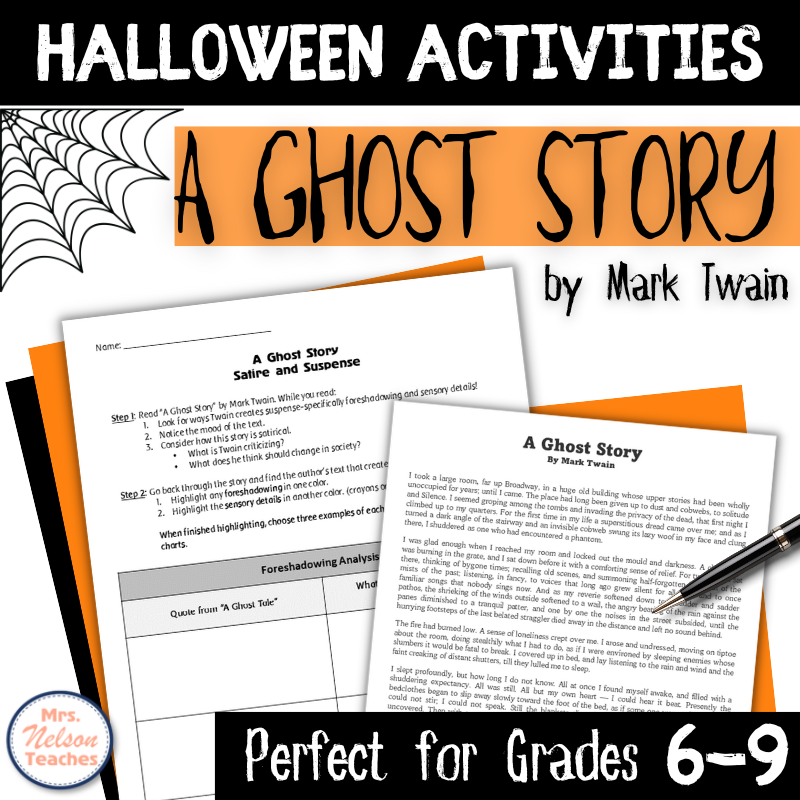
Do you like scary stories? I admit I am a total wimp when it comes to anything scary! But my middle school ELA students LOVE creeping themselves out with this scary story and Halloween activities! I love to use their love of all things scary to practice reading literature and improve their analysis skills! I recently discovered this often-forgotten gem by the one and only Mark Twain: “A Ghost Story.”

Scary Story Halloween Activities for Middle School

“A Ghost Story” – Mark Twain

Only recently had I discovered this story and I was absolutely delighted by it! In true Mark Twain fashion, satire is front and center in this story and provides a great opportunity to introduce satire to your students.

scary stories for middle school students

Based on the true story of one of the greatest hoaxes of all time, “The Cardiff Giant,” this fictional account begins with a chilling narrative of a hotel guest about to encounter something supernatural.

After hours of terror and, in an unexpected plot twist, the narrator finally meets the ghostly specter face-to-face. What follows is a hilarious and absurd conversation between the narrator and the ghost where Twain uses satire in his commentary on the general public and their gullibility.

Fun and Engaging Learning!

Trust me when I say that this is such a fun story to read with students! However, some background knowledge is required! Without the proper background knowledge, the story will likely not make sense and fall flat.

But don’t worry, I’ve got you! You know I love helping you build your students’ background knowledge!

Scary Story Halloween Activities for Middle School ELA

Here is a list of everything you will get with this Halloween Resource:

  • An Informational Article recounting the real history of “The Cardiff Giant.” (Absolutely vital for understanding the story!)
  • Slides Presentation teaching and reviewing the following topics.
    • Satire
    • Suspense
    • Foreshadowing
    • Sensory Details
    • Tone (review)
    • Mood (review)
  • “A Ghost Story” by Mark Twain (Full Text – it’s in the public domain)
  • “A Ghost Story” Student Assignment that asks students to analyze all of the topics listed above.
  • Additional Teacher Talking Points Sheet addressing:
    • Symbolism (specifically Twain’s use of light and dark in the story)
    • Social Commentary
    • Humor and Irony
    • Modern-day Connections (spread of misinformation via social media and the gullibility of individuals)
  • BONUS: Writing Assignment Asking students to write their own spooky story with a surprise ending.
  • Grading Rubric
  • Answer Keys!
Scary Stories for Middle School ELA Halloween Activities

This is truly a great way to dive into some fun Halloween Activities for Middle School ELA with your students during the month of October!

Until Next Time!

Brenna (Mrs. Nelson)

P.S. While these resources are available individually at a great price, you will get 20% off when you buy the Bundle! Check out the full Halloween Bundle below!

Unsubscribe | Update your profile | 113 Cherry St #92768, Seattle, WA 98104-2205


Vocabulary Games for Middle School

In order for middle school students to truly add new words to their personal vocabularies, they must work with the words multiple times over a length of time! While we could ask students to write sentences with the vocabulary words over and over again, that’s not nearly as fun as utilizing vocabulary learning games!

In my vocabulary resources, while I have included a review worksheet activity for each weekly vocabulary quiz, I LOVE  to play review games with my students!  It is such a fun way to get students moving AND working with the week’s vocabulary words at the same time!

Here are a few of my all-time favorite crowd-pleasing Vocabulary Review Games:

  • Garbage Can Basketball Vocabulary Game – Students are divided up into teams. Whem it is a team’s turn, I ask a team member to spell a word or provide its definition. If they answer correctly, the team member gets a chance to shoot a mini basketball into the (clean) garbage can or a Little Tykes basketball hoop if you have one. Another point can be earned from stating the definition.

    I usually have three masking tape lines on the floor to mark a 1-point shot, 2-point shot, and 3-point shot. The higher the risk, the higher the reward in this game!

    Ground Rules: Before a team can take a turn, everyone must be quiet. Points may be taken away for excessive talking or excessive celebrations! (Just call me the NFL.)

    vocabulary-review-activities-for-middle-school-ela
    You will have to use all your self-restraint to not unleash your inner Michael Jordan on your students!

    Some groups of students may need a little incentive to keep them engaged while their classmates are taking their turns. In this case, I have each student write down each word and definition as we go. In order for their team to win, each team member has to have an accountability sheet!
  • “The Board Game” – This vocabulary game is SO fun, but can get a little rowdy. I suggest setting clear behavioral expectations and enforcing them. Students are divided up into teams. One team member from each team comes to the whiteboard and finds a marker. When the entire class is silent, the teacher reads a vocabulary word’s definition. The students then race to write the word correctly on the board (in my class, they have to spell it correctly as well).
    vocabulary-review-games-for-middle-school

    When they think they have it correct, they must squat down so the teacher can see their answer. [Their answer is not considered submitted until they crouch down!] First person to spell it correctly and crouch down wins a point. If it’s close, I ask a student from a neutral team to help decide.
  • The Fly Swatter Vocabulary Game – For this game, you will need a projector and two fly swatters. Students are divided into two teams. The list of vocabulary words or definitions is projected on the board/screen. The teacher reads a word or definition and, using their fly swatter, students must point to the corresponding definition or word.

    The first one to point to the correct word or definition with their fly swatter wins!
    vocabulary-activities-for-middle-school

    Similar to the other vocabulary games, students must be quiet before each turn and an accountability sheet is a great way to keep students engaged when they aren’t the active player.
  • Partner Matching Game – Ask students to write each vocabulary word on a 3×5 card (or half a card) and each definition on a card. Students play memory/concentration in pairs

    This is a great vocabulary activity when you want students to be active, but don’t feel like leading a whole-class vocabulary activity.

Vocabulary Games are a great way to make learning new words fun for your middle school students!

Daily Vocabulary Activities

Each week, I use these games to reinforce our weekly vocabulary words!

Vocabulary Bell Ringers for Middle School ELA

Click HERE to see my vocabulary lessons in action!

(Vocabulary Activities also come in 7th Grade editions & 8th Grade editions.)

Games are such a great way to have fun and build relationships with students which only increases student learning!

What games do you like to play? Let me know!

Until Next Time,

Brenna (Mrs. Nelson)


5 Writing Prompts for St. Patrick’s Day

St. Patrick’s Day can either be a major distraction for students and teachers OR it can be a catalyst for learning! We know students will be thinking about the holiday. Rather than fight against it, put that energy to good use! These fun creative writing prompts will turn St. Patrick’s Day into an exciting learning adventure for your students!

(Not to mention, these prompts require very little effort on your part. Between the writing and sharing with the class, your students will be busy engaged for the entire class period!)

5 Creative Writing Prompts for St. Patrick’s Day

Ask students to respond to one of these writing prompts. As these are narrative writing prompts, I usually ask my students to include various elements of a good short story in their writing: well-developed characters, setting, plot, etc.

1. The Trip of a Lifetime!

st-patricks-day-writing-activity

You have won an all-expense-paid vacation to Ireland! You may bring three people with you for free. Who are you taking on this once-in-a-lifetime trip? What will you do while you’re in Ireland? What would this incredible opportunity look like for you? Write about your imaginary adventures!

2. Alone in a Castle at Night

st-patricks-day-fun-writing-activity

A long-lost relative has passed away and has bequeathed to you an ancient Irish castle. After traveling to Ireland to inspect your inheritance, you spend the night alone in the large castle. Despite your usual level-headedness, you find yourself feeling spooked. Describe your frightening night alone in the dark, cold castle! Use lots of sensory details and build suspense for your readers!

The Misunderstood “Man”

st-patricks-day-middle-school

The notorious villain, Dracula, was based upon an Irish folktale and immortalized by Irish author Bram Stoker. Using your imagination, write a story where Dracula returns to Ireland, not as a villain, but as a misunderstood creature. What is his experience? How does he try to convince the Irish inhabitants that he is harmless? How do people respond?

4. Show Me the Money!

st-patricks-day-middle-school

In the attempt to acquire his gold, you have set a trap for a Leprechaun. On the morning of St. Patrick’s Day, you discover that you have caught one! Now you only have to convince him to take you to his gold; however, you soon find that this is not as easy as it sounds. Describe your adventure with the Leprechaun! How do you convince him? How does he respond? Does he try to trick you in the process? How does the adventure turn out?

5. The Luck of the Irish

st-patricks-day-writing-activities

For one day, you have all the good luck in the world! Anything you attempt will be successful! There is no failure today! What would you do with your stroke of good luck? What will you accomplish? Who would you help? What would you do if you knew you couldn’t fail! Describe your entire lucky day!

Whether you assign one of these writing prompts or offer your students a choice, they will be sure to have lots of St. Patrick’s Day fun using their imaginations! For more St. Patrick’s Day activities, check out this bundle!


The Legend of Sleepy Hollow Easy Halloween Lesson Plan

the-legend-of-sleepy-hollow-middle-school

Many of our middle school students will be familiar with The Legend of Sleepy Hollow. With all the many film and television adaptations that have been produced over the years, many of them have been exposed to the story!

However, many of them have not read the actual text! Why? Well, Washington Irving seems to like his long description and silver-tongued vocabulary. In short, it’s a tough read for many middle school students.

That said, you know I’ve got your back!

Simplified Adaptation of The Legend of Sleepy Hollow

Now included as part of my The Legend of Sleepy Hollow resource, you will receive a simplified version of Irving’s short story. This adaptation remains true to the original story, but tones down some of the difficult early 19th century language. This more accessible version will allow students to dive deep into literary analysis!

the-legend-of-sleepy-hollow-easy-lesson-plan

In my classroom, I like to use this story to take a look at the characters and Irving’s use of characterization. I ask my students to examine closely the characters of Ichabod Crane, Brom Bones, Katrina Van Tassel, and The Headless Horseman.

Students also work on their paragraph writing skills as they write a character sketch for each! As a bonus, I’ve also included a context clue vocabulary assignment for students to practice identifying unknown words!

This is such a fun way to incorporate a little spookiness into your classroom this fall season! I love the way holiday lesson plans seem to engage students–even the reluctant ones–in learning on a deeper level!

If you’re looking for more spooky short story fun, check out the bundle!

Until next time,

Brenna (Mrs. Nelson)


Middle School Vocabulary Instruction that ACTUALLY Works!

Check out my ELA Vocabulary Warm-Ups that will change the way your middle school students learn vocabulary!

August. Is. Here.

It’s game time, people!

middle-school-ela

Raise your hand if you’re ready??!!

middle-school-ela

Truly, I hope you are feeling rejuvenated and energized and ready to tackle another school year! Your students are SO lucky to have you!

Here’s a little something that may help!

ELA Vocabulary Warm-Ups for the WIN!

The past couple of weeks I have been thinking about maximizing instruction time and effectiveness–specifically in the context of vocabulary instruction.

What I want to offer you today is a slightly unconventional method of teaching vocabulary.

Some may balk at this, but I promise you…

It. Actually. Works.

I’m sure we all are familiar with long lists of vocabulary words that students may (or may not) memorize for a week and then file away into the dark recesses of their brains for all eternity.

ela-vocabulary-lists

In all seriousness, while I really don’t want to knock anyone who uses this method (I’ve used it myself in the past), the problem that I have encountered in my own teaching experience is that students rarely remember any of the words.

I realized I was spending a lot of time on vocabulary instruction that just wasn’t effective.

A few years ago, I decided to think about vocabulary a little bit differently.

Deep-not Wide!

Instead of asking students to use their short-term memories to learn long lists of words for a week, I began asking students to learn and remember a short list of words for a month!

While at the beginning of each term, we started with just three words. We would build upon those words each week:

  • Week 1: We tested n words 1-3
  • Week 2: We tested on words 1-6
  • Week 3: We tested on words 1-9
  • Week 4: We tested on words 1-12
  • Week 5: We tested on words 4-15
  • Week 6: We tested on words 7-18
  • And so on…

At the end of the term, we would have a final vocabulary quiz that would assess students’ knowledge of all the words from that quarter.

Several weeks into this vocabulary experiment, I was thrilled to discover that it was working!

ela-vocabulary-words

My students who struggled on the weekly quizzes the first time they encountered the words, often had them mastered by the third and fourth weeks working with those words!

Students were using the vocabulary words in our conversations, their writings, and other classwork!

middle-school-ela

Additional Skill Improvement!

In addition to *actually* learning the vocabulary words, students were also improving in other areas that were incorporated into this vocabulary method, including: using context clues, learning about grammar, spelling, usage, conventions, etc. as they completed the daily warm-up activities.

Multiple Levels of Vocabulary

I have created vocabulary lists for 6th grade, 7th grade, and 8th grade

What does all this look like? Click here to view a short YouTube video with more info!

FREE Two-Week Trial

While I love this method, I realize it may not be for everyone. And that’s okay!

I would HATE for you to invest in a product that isn’t for you! To help you make an informed decision, I’ve created some totally FREE two-week trials for you to get a feel for this resource and decide if it’s for you or not!

6th Grade FREE Two-Week Trial

6th-grade-ela-warm-ups

7th Grade FREE Two-Week Trial

7th-grade-ela-warm-ups

8th Grade FREE Two-Week Trial

8th-grade-ela-warm-ups

When You’re Ready, Here are the Full 1st Quarter Versions!

6th-grade-ela-warm-ups
7th-grade-ela-warm-ups

(8th Grade Teachers: I love you and am wrapping up your full 1st quarter resource! The summer was busy and I’m still finishing it up! Stay tuned!)

ELA Vocabulary Warm-Ups: Introductory Offer!

I’ve been using these resources in my classroom for years, and I had every intention of having it packaged and ready for my store by now. Unfortunately, as I’ve shared, it’s been a jam-packed, non-stop summer and I’m not quite finished. I’m still putting some of it into a teacher friendly, ready-to-use format so it’s incredibly easy for you to use in your classrooms!

Just for fun (and because I love you guys), I’ve decided to post this in my store as a “Growing Bundle.”

middle-school-ela

What in the world is that, you ask? Let me ‘splain!

If you buy the 1st Quarter resources that I have posted now, they will cost you the price of that resource. BUT, as I finish packaging up the rest of the year’s warm-ups and vocabulary Slides, I will add them to this original product at NO ADDITIONAL COST TO YOU.

That’s right! If you buy now, you’ll get an entire year’s worth of vocabulary warm-ups, reviews, quizzes, conventions instruction, and more for one low price.

As I add to this resource, the price will go up to reflect the added value.

If you’re at all interested or think you might one day be interested, now is the time to buy!

Don’t miss out on this deal!

In the meantime, if you have any questions, email me and I will get back to you!

Until Next Time,

Brenna (Mrs. Nelson)


Informational Text Features for Middle School

Reading informational texts and other types of nonfiction becomes increasingly more important as our students progress through middle school. In high school and especially in college, students are expected to read large amounts of complex text and retain the information. The shift from “learning to read” to “reading to learn” generally begins in middle school.

As such, I try to include informational texts as often as possible in my class–even when we are studying fiction! For example, when we are studying The Witch of Blackbird Pond, we read a lot of texts that provide historical context for the novel. When we read Freak the Mighty, we read about learning disabilities. The more students are exposed to and work with informational texts, the less foreign it will feel to them. They will gain confidence in their ability to read these (seemingly) more difficult texts.

Strategies for Reading Informational Texts

Of course we don’t just *read* the informational text. All along the way, I am teaching my student strategies for navigating these texts! For example, on of my favorite strategies to use is teaching students about annotating a text. Annotating really helps students engage and interact with the text, which helps them retain the information so much better! This is an especially useful skill for students who plan to go to college!

Another strategy that I like to arm students with is SQ3R. SQ3R is a five-step approach to reading a text and serves as a great self-check for students to use to ensure they are comprehending what they are reading. The steps of SQ3R are 1) Survey; 2) Question; 3) Read; 4) Recite; and 5) Review.

Using Text Features as a Strategy

Generally, I like to begin the year teaching students how to identify and use Informational Text Features to aid their comprehension of nonfiction texts. Many students might be familiar with these text features, but I am often surprised at how many middle school students haven’t quite grasped how to use them to their advantage.

informational-text-features-middle-school

For about a week, I like to immerse my students in using informational text features.

We identify text features.

We explain how each text feature helps readers.

Sometimes, we even compose our own writing that includes text features!

informational-text-features-middle-school

By the end of this short unit, students are incredibly familiar with informational texts and know exactly how to use the features for their own benefit!

Text Features as Test Prep

While I usually complete these text feature activities with my students at the beginning of the school year, I also like to revisit them at the end of the year in preparation for any end-of-year exams we may have. Reading and Language Arts exams often include several nonfiction and informational texts and like to ensure my students are prepared!

informational-text-features-middle-school

What strategies do you like to use to help your students approach informational texts?

Until next time!

Brenna (Mrs. Nelson)


How to Write Hooks!

You would think that a blog post about writing hooks would have an incredible hook.

how-to-write-hooks

Perhaps I am getting wimpy in my old age, but I am hesitant to even try it! You’ll have to settle for a GIF!

how-to-hook-a-reader

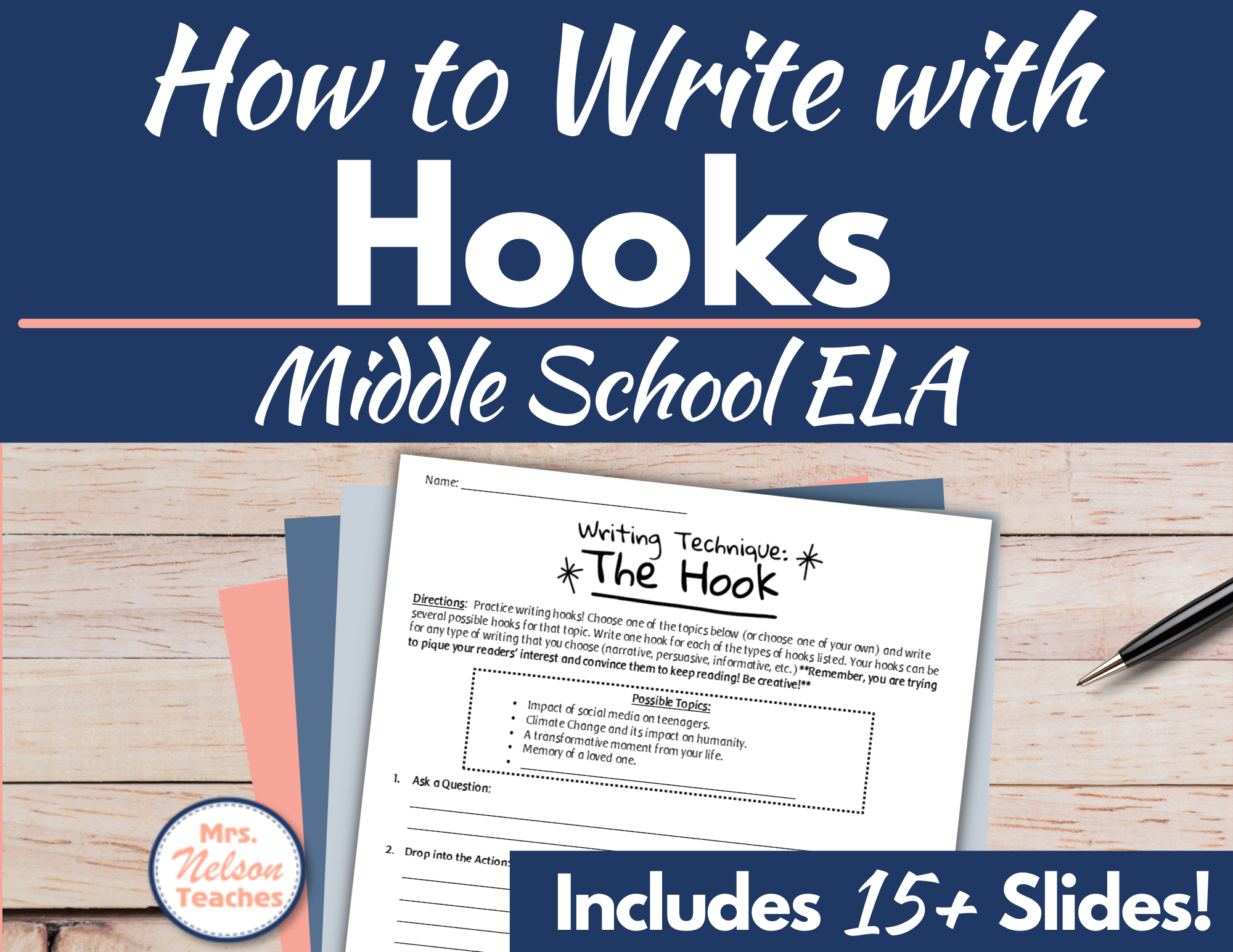
What I will dare to do is introduce you to a new product that teaches secondary students how to write hooks!

how-to-write-a-hook

This writing mini-lesson includes everything you need to teach student how to write hooks. Beginning with an instructional Slides presentation, students will about learn five different types of writing hooks as they take notes on the included note-taking handout.

writing-hooks-activities

Students can then practice writing hooks with a short practice activity, followed by a longer writing activity. A classroom anchor chart as well as student-friendly bookmarks are included to help students remember the content.

writing-hooks-activity

Teaching students to write well can be incredibly tricky. I think it takes a lot of intentional direct instruction, examples, teacher modeling, and PRACTICE! In my class, I like to sprinkle writing assignments throughout all of my units, so that students are more comfortable with putting their thoughts down on paper (or computer screen). That way, when we do come to more formal writing assignments, it isn’t such a shock to my students. For this reason, parts of this lesson are included in my Unbroken unit.

If you haven’t read Unbroken yet, you should! It’s an incredible story of inner strength and resilience. My unit is centered around the young adult version of Unbroken, but the original version is also a great read. The author, Laura Hillenbrand, includes a masterful hook at the beginning of the story. It’s a fantastic real-life example of a hook and I love using it to show my students the power of an incredible hook!

What other real-world examples of hooks can you think of? Share in the comments!!

Until Next Time,

Brenna (Mrs. Nelson)